Author: Andrew Dressel

  • Essentials for Business Contracts: Three Must-Haves

    Essentials for Business Contracts: Three Must-Haves

    Contracts are core documents for business operations. Businesses may rely on contracts to: 

    • Conduct transactions with outside parties
    • Handle internal functions like employment contracts
    • Limit legal liability to protect the company and its owner

    To truly serve its purpose, a contract must clearly define the obligations and responsibilities of all parties—and the terms must be laid out in detail so that they are enforceable. 

    A New Jersey business contract attorney can help you understand the essentials of business contracts. Business attorneys are equipped to look out for your best interests and help you avoid costly litigation.

    You can get a jump start on understanding business contracts today by learning three essential guidelines to follow for effective contracts. That way, you’ll be ready to take full advantage of professional advice from a business attorney.

    Three must-have features for your business contracts

    1. Make your contract’s language clear and simple

    Breaching a contract is more likely when parties don’t fully understand the terms and conditions of that contract. Meanwhile, clearly-written contracts are less likely to be challenged in court if one of the parties fails to meet their obligations.

    To be considered legally enforceable contracts under New Jersey law, contracts must contain three specific elements: 

    • A definite offer
    • Acceptance of the offer
    • Consideration

    If any of the elements of a contract are missing or questionable, the court could rule that the parties did not have a legally binding agreement.

    Offer

    It may sound obvious, but for a contract to be valid, the offer must be communicated to the other party. An offeror makes an offer to sell a product or property, perform a service, or engage in a business venture. The person who receives the offer is the offeree

    An offer is dependent on a specific promise, act, or forbearance (lack of action).

    An offer must be definite and clear so that the offeree understands that an offer is being made and that accepting the offer creates a binding contract. 

    The offer must also be specific enough to describe what is being offered. For example, in real estate, a legal description of property is more than just a street address, and often includes specific boundaries as measured by a surveyor.

    Acceptance

    Acceptance is the act of consenting to and approving the terms and conditions of the offer. When an offer is accepted, this creates a legally binding contract between parties. If a party fails to fulfill the terms and conditions of their agreement, the contract provides the other party with legal recourse.

    An acceptance only occurs when the acceptance is unqualified and unequivocal. The offeree must agree to the exact terms of the offer as specified by the contract. 

    If an offeree states they will accept the offer with changes, there is no binding contract. Instead, the offeree has made a counteroffer which must then be communicated to the offeror.

    Consideration

    Consideration is an exchange of promises or performance for something of value. Consideration can be money, an item with economic value, or a promise to perform or not perform specific acts.

    The consideration does not need a minimum value for a contract to be valid. Both parties must receive something from the agreement. Courts can enforce a contract even if a party receives something of nominal value. An example would be a real estate contract transferring property for “$1 and Love and Affection.”

    Without consideration, a contract is not enforceable. Consideration is what distinguishes a gift from an enforceable contract.

    2. Provide sufficient detail about expectations and obligations

    Contractual obligations are the legally binding promises that make up a business contract. They explain the rights and responsibilities of each party to the contract. Therefore, it is essential that terms and conditions be crystal clear before either party enters into a contract.

    It might be tempting to write short contracts to avoid dealing with long and difficult-to-understand documents. However, trying to keep things “short and sweet” could mean leaving out details essential to protect parties from liability. 

    Suppose a dispute or breach of contract occurs. In that case, a lack of detail can make it impossible for a judge, mediator, or arbitrator to understand what the parties intended when they signed the contract.

    The goal is to draft a business contract that is straightforward and simple enough to understand, but with sufficient detail to avoid ambiguity about the responsibilities and obligations of either party. The terms and conditions of the contract should be clear to anyone reading the contract without either side having to explain what they thought or assumed the contract covered.

    Here are some points to keep in mind:

    • Avoid acronyms and spell everything out
    • Never assume anything when writing a contract—if the reader must assume something, the contract is missing details
    • Have a neutral third party review the contract to ensure that the terms are easily understandable, such as a New Jersey business contract attorney 

    A contract should include sufficient detail to remove all uncertainty about what is expected and provide a way to assess whether the parties have complied with the contract terms.

    3. Get everything in writing

    Verbal or oral contracts are enforceable under New Jersey contract law, with some exceptions. 

    For example, contracts governed by the New Jersey Uniform Commercial Code, New Jersey Consumer Fraud Act, and the Statute of Frauds and Fraudulent Conveyances must be in writing to be enforceable. 

    Other contracts that must be in writing include, but are not limited to, contracts involving employment agencies, home improvement contractors, prenuptial agreements, and automobile sales.

    But even though some oral contracts are enforceable, they aren’t the gold standard. A written contract provides the fullest possible protection to all parties involved. 

    Reasons to use written business contracts include:

    • Increased clarity of responsibilities, obligations, prohibitions, and consequences for breaching the contract  
    • Better protection from liability and other adverse consequences
    • Financial savings by avoiding disputes and litigation
    • Enhanced trust between parties
    • Pre-determined strategies for resolving disputes

    Written contracts are generally more enforceable than verbal ones, but merely signing a written contract does not make the contract enforceable or create protection for your business. Therefore, it is important to seek legal advice from an experienced New Jersey business contract attorney when creating or entering into a business contract.

    Need help preparing your New Jersey business contract?

    Negotiating, drafting, and reviewing contracts is essential to operating a successful business. A well-drafted contract is a strategic way to protect your business from disputes and costly litigation. 

    Our New Jersey business contract attorneys at The Law Offices of Andrew Dressel LLC provide comprehensive legal services to ensure your business is well-positioned with enforceable contracts if things do not go well during a business transaction.

    Contact our law firm for a free virtual consultation if you need help preparing or reviewing New Jersey business contracts.

    The content in this article is for general informational purposes only. It should not be construed as legal advice or a substitute for legal advice. The information above does not create an attorney-client relationship. Any reliance you place on such information is therefore strictly at your own risk.


  • You Could Say Anything: Succession, Securities Fraud, and the Consequences of Misrepresentation

    You Could Say Anything: Succession, Securities Fraud, and the Consequences of Misrepresentation

    “It’s enough to make you lose your faith in capitalism—like, you could say anything.”

    This statement, from Kendall Roy, reads like a thesis statement for the back half of this last season of Succession. In episode six, “Living +” Kendall makes grand promises about technology that have never been vetted (sound familiar?), juicing the financial projections of his new product, and editing his dead father’s own recording to make predictions on new, supposedly life-expanding, technology. 

    At the end of it all, his company’s stock price jumps.

    And then in the following episode, “Tailgate Party” we learn that Kendall’s foil, Lucas Mattson, is also juicing his own numbers. Mattson sheepishly admits to Shiv Roy that GoJo’s subscriber in India has been vastly overstated, to the extent that the numbers would require “two Indias” to make sense.

    Of course, you cannot, in fact, “say anything” and both Roy and Mattson are keyed into the fact that the other’s misrepresentations are their weakness. In fact, each character may have potentially committed significant acts of securities fraud.

    What is securities fraud?

    Demonstrating securities fraud can be complex, but the concept behind it isn’t: securities fraud involves the misrepresentation or omission of information in an attempt to deceive investors and manipulate the financial markets.

    Securities fraud can involve a wide range of activities, but generally speaking, it’s composed of six basic elements:  

    1. Material misrepresentation or omission by the defendant
    2. Scienter
    3. Connection between the misrepresentation or omission and the purchase or sale of a security
    4. Reliance upon the misrepresentation or omission
    5. Economic loss
    6. Loss causation

    Breaking down securities fraud on Succession

    How would a potential case of securities fraud against both Kendall Roy and Lukas Mattson play out in court? Let’s look at the different factors and how each character’s actions stack up.

    Creating material misrepresentation

    Both Roy and Mattson have ticked the box for the first requirement of securities fraud: each has made a material misrepresentation. 

    Mattson’s is clearer, as he knowingly misrepresenting the number of subscribers to his company’s product. Kendall’s is a little murkier, as he intentionally fogs things up, posing the potential health benefits as hypotheticals. His aggressive financial projections are positioned as just that—projections. 

    However, Kendall omits the real questions behind these forecasts and projections. He also alters his father’s video to make a claim his father, the influential former CEO, never made, a clear misrepresentation (although again the alteration is to a forecast, not a statement of fact; Kendall is careful to create some plausible deniability).

    Scienter and false statements

    Scienter speaks to the state of mind of the issuer of the false statement: did they know it was untrue? 

    In Succession, both characters here are clearly in the know: Mattson is fully aware that his numbers are nonsense, and so does Kendall. 

    In short: if a factfinder at trial had access to the same evidence the audience does, this element is clearly satisfied. 

    Sales, reliance, economic loss, and loss causation

    Assuming people are making stock purchase decisions based upon these statements, the rest of the criteria for securities fraud could be quickly met. A critical factor, of course, is the movement of the financial markets. Assuming stock prices drop once the truth is revealed, economic loss and loss causation potentially follow. 

    Loss causation requires a showing that of either:

    1. A corrective disclosure revealing the fraud to the public followed by a significant decline in stock price, or 
    2. That the events causing the investor losses were a foreseeable consequence of the fraud and within the zone of risk the securities law were designed to prevent. 

    While this can sometimes be a high bar to clear, in these cases, especially Mattson’s, the bar is well-cleared.

    How common is securities fraud?

    While this all makes for good television, how often does something like this happen in reality?

    We know Waystar Royco is a massive publicly-traded company. Assuming the same is true for GoJo, the answer is not very often at all. 

    Publicly-traded companies are required to make quarterly disclosures, which are audited. Moreover, companies aren’t just under the watchful eye of the auditors. They’re also under the watchful eye of professional short sellers like Citron Research, whose mission is to cast a skeptical eye on statements and projections of publicly-traded companies. 

    This means that if GoJo was overstating its India subscriber numbers by a factor of two, this information would quickly come to light. Mattson even hints at this in the most recent episode, complaining, “I don’t want some forum monkeys just shorting me.” 

    Indeed, it’s hard to recall a large publicly-traded company engaged in this level of fraud since the days of Enron, Worldcom, and Tyco. 

    Navigating securities fraud matters? We can help.

    In the world of non-publicly traded companies fraud is—while not commonplace by any means—more common. And when securities fraud is in question, the stakes can be extremely high. 

    The Law Offices of Andrew Dressel LLC is a commercial litigation boutique that aids in both the prosecution and defense of claims of fraud, including securities fraud. If you have been accused of fraud, or believe you have been the victim of a fraud, please contact us online or give us a call at 848.202.9323.

    The content in this article is for general informational purposes only. It should not be construed as legal advice or a substitute for legal advice. The information above does not create an attorney-client relationship. Any reliance you place on such information is therefore strictly at your own risk.

  • Daniel Valverde: Spring 2023 Social Justice Scholarship Winner

    Daniel Valverde: Spring 2023 Social Justice Scholarship Winner

    Daniel’s Winning Essay:

    Daniel Valverde: Spring 2023 Scholarship Winner | The Law Offices of Andrew Dressel LLC

    My experience with progressive social justice consists of developing more affordable housing. As a way to reverse injustices of racial and economic disparities that continue to hurt various communities. Through my professional experiences in affordable housing, I quickly noticed the lack of diverse representation in the field.  I observed the detrimental effects of city planning and policy decisions that have hurt marginalized communities.  Due to the lack of affordable housing, there is a growing number of long-time residents experiencing displacement, which also attributes to the public health crisis of a growing number of individuals experiencing homelessness.

    After earning my Undergraduate degree, I decided to pursue a career in public policy. Post-graduation from UC Davis, I was granted the opportunity to intern at the Housing Leadership Council of San Mateo (HLC). I was later offered a full-time position as an Organizer. HLC is a non-profit organization that advocates for affordable housing developments and policies, which is where I discovered how politicized housing issues have become. Although I thoroughly enjoyed my time at HLC, as a visual learner, I felt that I needed to gain an additional understanding of housing, which led to my employment transition into a Junior Real Estate Development Manager (Assistant Project Manager) with Visionary Home Builders of California, Inc. (VHB).

    Working with VHB, a nonprofit developer located in Stockton, California had assisted me in understanding how affordable housing development is built. VHB developments were centered around family housing. However, my interests included developing for seniors, people with special needs, and Veterans. After two years with VHB, I had transitioned into my current position at Jamboree Housing Corporation, where I am performing similar roles, assisting the Senior Director and Project Managers with tasks necessary to acquire, finance, design, entitle, construct, and occupy affordable housing projects.

    I am currently enrolled in a Master’s in Public Administration program from the University of San Francisco. This program will further prepare me for public leadership by the challenging curriculum and applying this to aspects of the real world. Through my current and previous work experiences, I have realized how innovative partnerships between private, public, and non-profit sectors can help build housing and bring services to residents and the surrounding communities, which allows for equitable access to services for low-income residents. By obtaining this degree, I will have gained skills and abilities to be a leader within this career in learning areas of strategizing and implementing policies that will alleviate the displacement of current and long-term residents in the community and building more housing.

  • Affordable Housing Advocate Wins The Law Offices of Andrew Dressel LLC’s Spring 2023 Social Justice Scholarship

    Affordable Housing Advocate Wins The Law Offices of Andrew Dressel LLC’s Spring 2023 Social Justice Scholarship

    Affordable Housing Advocate Wins Dressel/Malikschmitt’s Spring 2023 Social Justice Scholarship

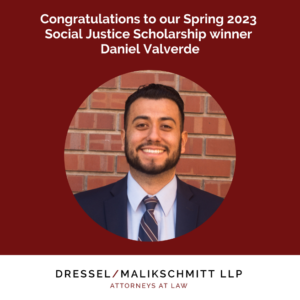
    We are pleased to announce the winner of our Spring 2023 Social Justice Scholarship is Daniel Valverde, a student in the Masters of Public Administration program at University of San Francisco. Valverde’s studies focus on the equitable development of affordable housing.

    In his application, Valverde stressed that his previous work experience had “helped me understand how land-use planning and decisions are vital to future sustainability, population, and economic growth for communities. But it is also important to be mindful to implement land use policies that will make communities equitable and inclusive for all community members.”

    Valverde’s focus on bridging the gap between scholarly research and the real-world is what made Daniel’s scholarship application stand out to firm founders Andrew Dressel and Chris Malikschmitt.

    “We always say education is the foundation from which change is built,” said Andrew Dressel. “When it comes to affordable housing policy, we mean that literally. The research Daniel is doing could have a huge impact on communities across the country.”

    “We are proud to support Daniel in his studies,” added Chris Malikschmitt. “We share his passion for making the world a better place.”

    Valverde received a $1,000 scholarship from The Law Offices of Andrew Dressel LLC for the Spring 2023 semester. This is the third time the firm has awarded this scholarship, and it plans to continue doing so. Students interested in applying for the Fall 2023 award should visit stag.webx.win/scholarship.

  • Pending Legislation Would Unsilence Victims Of Workplace Abuse

    Pending Legislation Would Unsilence Victims Of Workplace Abuse

    One of the foundational goals of the #MeToo movement was encouraging the victims of workplace abuse and harassment to speak up so everyone would be aware how pervasive of a problem it is. However, many victims of employment discrimination are barred from telling their story by non-disclosure agreements signed as part of a lawsuit settlement or severance package. 

    In order to give victims a voice, the New Jersey Legislature passed a law banning the use of non-disclosure agreements in cases involving certain workplace issues, like harassment and retaliation. Since the law went into effect in 2019, victims have been able to speak out about what happened to them… or so everyone thought.  

    This summer, a New Jersey Appellate Court ruled the 2019 law banning non-disclosure agreements does not cover non-disparagement clauses. The ruling in Savage v. Township of Neptune, 472 N.J. Super. 291, created a lot of confusion in the employment law world. Victims are upset, and employers who want to quietly settle sexual harassment suits are rushing to do so while they have a way to keep them quiet. But perhaps nobody was more shocked by the court’s decision than the legislators who drafted the 2019 law. 

    As a law firm that handles a lot of employment law disputes for small to mid-sized companies in central New Jersey, The Law Offices of Andrew Dressel LLC has been keeping a close eye on these developments.  

    What’s Happening Now?

    The latest action in this area is once again on the legislative front. In a direct response to the opinion in Savage, New Jersey lawmakers introduced A4521, which would clarify that the current law on non-disclosure provisions also prohibits certain non-disparagement provisions in employment contracts and settlement agreements.  

    This sort of swift, targeted response to the courts is unusual, and highlights the importance of this issue.  

    Right now, the bill is sitting in the Senate Labor Committee waiting on a hearing. It passed the Assembly in a landslide with 59 members voting yes, 9 no’s, and 4 abstentions. 8 members did not vote.  

    If passed into law, this legislation would become effective immediately, and apply to “all contracts and agreements entered into, renewed, modified, or amended on or after the effective date.”  

    A Few Other Changes To Note

    We also want to note that the bill “removes a provision of current law that provides that the prohibition on non-disclosure agreements does not apply to the terms of any collective bargaining agreement between an employer and the collective bargaining representative of the employees.” And “permits mediation or arbitration clauses to be included in an employment contract that is a result of a collectively bargained agreement for claims related to discrimination, retaliation, or harassment.” Unlike the outright ban on non-disparagement provisions, these changes won’t impact every employer. But larger employers who have collective bargaining agreements with their employees should be aware of this potential update.  

    And for anyone concerned that the bill’s broad language allowing employees to speak freely about their past employment could create some problems when there is a non-compete agreement in place, the drafters thought of that. The legislation states: 

    Notwithstanding any other provision of law to the contrary, this section shall not be construed to prohibit an employer from requiring an employee to sign an agreement: 

         (1)   in which the employee agrees not to enter into competition with the employer during or after employment; or 

         (2)   in which the employee agrees not to disclose proprietary information, which includes only non-public trade secrets, business plan and customer information. 

    However, as we noted in a previous blog post, the New Jersey Legislature is taking steps the significantly limit the use of non-compete agreements, so this might end up being a non-issue. 

    Contact The Law Offices of Andrew Dressel LLC Today for Advice on Employment Contracts and Settlement Agreements

    Any New Jersey employer that includes language limiting the ability of current and former employees from speaking out about their job should take note of this pending legislation, and consider how they want to react if it becomes law.  

    New Jersey businesses have relied on non-disclosure and non-disparagement clauses for decades as a way to protect their assets and encourage the quick settlement of employment disputes. Taking away this tool without considering what other means might be used to accomplish these goals is risky.  

    The Law Offices of Andrew Dressel LLC is advising a number of businesses in New Jersey and beyond as they consider whether to make changes to their existing employment documents. Please contact our experienced team of attorneys to schedule a meeting if this is a topic we can assist you with.  

  • Ronion Brown: Fall 2022 Social Justice Scholarship Winner

    Ronion Brown: Fall 2022 Social Justice Scholarship Winner

    Ronion’s Winning Essay:

    Ronion Brown: Fall 2022 Social Justice Scholarship Winner | The Law Offices of Andrew Dressel LLC

    Becoming an advocate and service to others in the disabled community is my purpose. Being born with mild cerebral palsy influenced my passion for becoming a mentor for disabled children. My condition did not allow me to have a normal childhood because I was restricted from many activities. Although I have progressed with support from my doctors and family, achieving my dreams has not been easy. I plan to launch a daycare and community center for young children that will allow me to support children who have similar circumstances.

    My education will allow me to thrive in my career of molding children’s lives. I love the idea of teaching and guiding young children. They will learn skills to become successful individuals. My community and daycare center will offer services to assist them with any issues. The focus of my organization is addressing the needs of those with Cerebral Palsy and other development issues. The services in my organization will increase their overall development according to the needs of each child. My goal is to build a community for children to call their second home and view each other as equal while receiving guidance and resources to prepare them for the future.

    I have also joined organizations at my university to receive concrete preparation for my future career and support important causes in the community. The Beacon Club advocates for disabled students on campus to promote that disability does not mean disabled, but differently-abled and within everyone’s ability to be inclusive. Similar to my mission of educating and guiding developmentally impaired children. I joined the Beacon Club because this organization represented me and my career goals to guide children. The Collegiate Entrepreneurs Organization is an intellectual and service-oriented organization founded to inspire, educate, and cultivate knowledge. This organization helps members develop an entrepreneurial spirit and a dedication to the stakeholders of the University of Louisiana at Lafayette as well as the Greater Acadian region. Students gain insight through guest speakers, interaction with local businesses, workshops, and networking events. I joined the collegiate entrepreneurs’ organization to prepare me for the business portion of my career.

    To achieve my dreams of launching a daycare and community center is not about gaining a career but transforming the lives of disabled children. Teaching children is essential because they are not influenced by their environment or society’s standards. Children are the future and should have access to an equal education regardless of their circumstances. So, guiding disabled children to success will become my mark. We will prove that a disability does not mean inability together and eliminate the stereotypes of the disabled community.

  • The Voyager Bankruptcy: Your Questions Answered

    The Voyager Bankruptcy: Your Questions Answered

    On July 5, 2022, the popular cryptocurrency services firm Voyager filed a petition for Chapter 11 bankruptcy. With over three million customers, Voyager’s bankruptcy has had rippling effects throughout the cryptocurrency industry. The Law Offices of Andrew Dressel LLC has received numerous inquiries from affected customers, as well as others within the industry, about what could happen going forward and what Voyager customers could do to protect themselves. This blog is designed to answer some of the most common questions.

    What is/was Voyager?

    Voyager is a family of companies providing financial services in the cryptocurrency industry. Specifically, Voyager provided three main services: (1) it was a broker, allowing buyers and sellers of various crypto-tokens to match with each other; (2) it provided deposit services, whereby depositors could store their crypto-assets while earning interest; (3) it provided lending services by which customers could borrow tokens and pay interest. In layman’s terms, Voyager was a “crypto-bank.”

    What Went Wrong?

    While Voyager has largely been the victim of an overall downturn in the crypto-markets, the real deathblow has come from the fall of the Singapore-based hedge fund Three Arrows Capital. Three Arrows had invested hundreds of millions of dollars in the Luna token, developed by Terraform Labs. Luna was backed by TerraUSD, a “stablecoin” tied to the value of the US dollar.

    However, due largely to panic selling during the general crypto downturn, TerraUSD became unpegged from the dollar, leading to a collapse in TerraUSD and a subsequent collapse in Luna. This led to huge losses for Three Arrows and equally huge losses for one of its largest lenders, Voyager.

    On June 23, 2022, Voyager first signaled its troubles to customers by lowering its withdrawal limit to $10,000 (it had previously been $25,000). On July 1, 2022, Voyager suspended all trading, deposits, and withdrawals. On July 5, 2022 it filed for Chapter 11.

    What is Chapter 11 Bankruptcy?

    Chapter 11 bankruptcy is a process by which a business can be reorganized in order to be in a position to better pay out its creditors. It does not mean that the company is without assets, it simply signals that the company at issue is in significant financial distress and requires reorganization. The most important effect of the Chapter 11 petition is the automatic stay on collections efforts by creditors.

    Are the Customers Creditors?

    The present petition lists customers as creditors, but it is unclear precisely how these creditors will be treated under any proposed reorganization. It seems Voyager may be approaching this reorganization by taking the position that it is a broker/dealer operation, in which case customers would have some priority of claim. However, there are other large creditors out there, including Sam Bankman-Fried’s crypto-fund, Alameda Ventures. Those creditors may seek to oppose such a designation in order to receive priority on payment. The potential is there for lengthy litigation over these very unique bankruptcy issues.

    What Can a Voyager Customer Do?

    Unfortunately, the bankruptcy process can be a lengthy one, and this one appears set to be especially contentious. Bankman-Fried seems to be viewing this as an opportunity to acquire either Voyager or Voyager’s customers. Indeed, Bankman-Fried has sent out, via Twitter and other media, offers to Voyager’s customers about transferring their assets to FTX, Bankman-Fried’s rival platform. The Law Offices of Andrew Dressel LLC has no view on that offer, including whether it is a valid offer under United States bankruptcy law.

    While we believe it is unlikely to matter much in the context of bankruptcy law, especially now that a bankruptcy petition has been filed, The Law Offices of Andrew Dressel LLC does believe it is a prudent move for customers to continue to contact Voyager’s customer relations team in order to express any interest in withdrawing funds or moving them to another platform, if a customer has such interest. Again, given the ongoing bankruptcy process, it is not our view that these requests are likely to result in any action on Voyager’s part. However, our firm does not see the harm that could come in providing such a notice if it reflects a customer’s actual interest.

    If you wish to discuss the Voyager situation further, please visit our website www.d-mlaw.com and complete an online contact form or call us at (848) 202-9323. The above is not intended to constitute legal advice and should not be relied upon as such.

  • Matthew Locke: Spring 2022 Social Justice Scholarship Winner

    Matthew Locke: Spring 2022 Social Justice Scholarship Winner

    Matt’s winning essay:

    I have worked with children and their families as a middle school teacher and basketball coach for the past seven years. From Brookyln to the Bronx to Chicago, immersing myself into diverse communities has essentially been at the heart of my job. Although I originally planned to attend law school immediately after graduating from college in 2012, I decided to spend a year teaching instead and genuinely enjoyed it so much that I decided to continue much longer. Besides my love for kids in general, the reason this work was so gratifying for me is because it gave me an opportunity to push, motivate, and inspire the youth who hold unlimited potential.


    Ultimately, however, I decided that I could make a greater impact on the field of education with a law degree. I am particularly sensitive to issues relating to children who deal with trauma, and my interest in family law stems from my desire to ensure all kids feel safe both at school and at home. I come from a large family—my parents had six children and adopted three children as well. To this day, I admire the resiliency and positive attitude of my adopted siblings who were unable to meet or establish a healthy relationship with their biological parents. Yet my teaching experience has shown me that there are too many children who deal with trauma in ways that affect their ability to learn, and they often do not have someone who will strongly advocate for them. In many cases it seems that the legal system has failed these children, and I am hoping to be a part of the solution.

    I grew up in the south suburbs of Chicago and have lived on the south side of Chicago for the past two years. I currently work part-time for my state representative in the 33rd district of Illinois, which includes parts of Chicago. This community is very special to me. While I cannot say for sure what I will be doing ten years from now—practicing family law, working for the Department of Education, going into politics, or opening my own school—I can say for sure that my desire is to work in a way that gives back to the children and families in Chicago.

  • Cryptocurrency Courtroom Tales: $100 Million Judgement Victory

    Cryptocurrency Courtroom Tales: $100 Million Judgement Victory

    It’s not often that a defendant will label a $100 million dollar judgment against him as a “victory,” but it’s a surprising result of current cryptocurrency courtroom disputes. It was precisely the label Craig Wright attached to a jury’s award earlier this month in the action filed against him by Ira Kleiman, the brother of Wright’s business partner David Kleiman.

    Anonymous Bitcoin Creator Unmasked?

    Why would a $100 million dollar award be considered a victory? Because the plaintiff here was seeking an award of half of 1.1 million Bitcoin (BTC), a potentially staggering sum, worth well over $50 billion. But just as interesting is the theory behind the recovery. Wright has long claimed to be Satoshi Nakamoto, the still anonymous creator of Bitcoin, and Nakamoto, or some other very early Bitcoin miner, has a stash of 1.1 million BTC, created at the initial stages of Bitcoin mining, and untouched since. Wright’s claims have long been doubted, and Wright has not produced any firm evidence of his claim, but interestingly both parties took the position that Wright is Nakamoto in presenting their cases. Whether Wright is Nakamoto, a claim for which Wright has never put forth any evidence, was not actually an issue before the jury.

    Plaintiff’s Attorneys Fail to Establish Early Partnership

    So why isn’t Mr. Kleiman coming home with half of 1.1 million Bitcoin? Putting aside the issue of whether Wright is Nakamoto, Plaintiff still had to establish that Wright and David Kleiman had a partnership related to the creation of Bitcoin or the initial stages of Bitcoin mining. Based on the jury’s verdict, it appears that Plaintiff’s attorneys failed to do so. What they did establish, however, was that there was a joint venture, W&K Information Defense Research LLC, which was involved in the creation of software that helped make blockchain and cryptocurrency technologies possible. The fruits of those efforts entitled Plaintiff to $100 million.

    Trial Just the Start of This Story

    However, Plaintiff has another problem waiting in the wings. There are other members of W&K Information Defense Research LLC, including Wright’s ex-wife and his current wife, who dispute Kleiman’s ownership interests in that enterprise and his right to bring suit on that enterprise’s behalf. Depending on how those disputes play out, Kleiman’s recovery could be reduced even further. Those disputes are currently playing out in Palm Beach County court.

    And then there is the question of how Wright will pay the $100 million verdict. Will it involve liquidation of BTC? And will it involve litigation of part of the 1.1 million BTC at issue in this matter? One can only guess what effect the liquidation of about 2,000 of those original BTC would have on crypto markets. As is usually the case after trial, the story is far from over.

    The attorneys at The Law Offices of Andrew Dressel LLC are experienced litigators in the cryptocurrency and blockchain spaces. If you would like to contact one of our attorneys, please reach out via email at contact@d-mlaw.com, call at 848.202.9323, or visit our website www.d-mlaw.com.

    Disclaimer: Please note that any legal question requires consideration of individual facts, and this article is not intended as legal advice to any individual or business and should not be relied upon as such.

  • SQUID Crypto Token and Dangers to Investors

    SQUID Crypto Token and Dangers to Investors

    The story of the SQUID crypto token is a perfect illustration of the opportunities cryptocurrency permits for scammers and the dangers it poses for investors.

    The SQUID token was a game token, ostensibly used to play games within the internet environment made by the token’s creators. Like many game tokens, it had a play-to-earn system, but primarily investors were buying from other speculators, including the token’s creators. Tied to a pop culture phenomenon, the token quickly attracted buzz and its rise was truly meteoric. At its height, SQUID was trading at about $2,800. And then within ten minutes it was worth $0.

    What Happened—Heard of a Rug Pull?

    So, what happened? It was something called a “rug pull.” The creators of the coin sold off a large amount quickly, leaving no liquidity left in the exchange. Essentially this is a pump and dump for crypto and it is something that happens with some frequency in pop culture-based tokens. Indeed, the SQUID token story is a virtual beat-for-beat repeat of the MANDO (as in Mandalorian) token earlier this year. Again, there was a token tied to a hot IP property, again, there was hype and again, there were investors left holding the bag after the price plummeted—the classic “rug pull.”

    Red flags were there for investors. The white paper and the website for the token were riddled with typos, which is a good indicator that this was something hastily put together to capitalize on a trendy topic. The token’s official social media accounts were also designed to prevent token holders from communicating their concerns. Moreover, the token system was designed to prevent non-insiders from selling. The SQUID token had to be converted to another token before it could be sold. This meant outsider funds were essentially locked up while insiders could sell off.

    The SEC and its Role in Preventing Crypto Currency Scams

    Scams such as these beg the question of when the SEC is going to step in and begin aggressively enforcing securities laws in the crypto space. These projects have gone well beyond the decentralized monetary future imagined by Bitcoin’s early adopters. New tokens are largely centralized plans tied to some sort of platform that is centrally managed, with gaming tokens being among the most popular versions of these centralized tokens. However, many purchasers are buying these tokens with an eye, not towards gaming, but towards investing.

    Gaming is a perfectly legitimate use for blockchain-based crypto currency tokens. Projects like Zed Run and Decentraland are making a compelling case for in-universe tokens. But gaming tokens also have become a ripe environment for scammers and, unless the SEC or some other governmental entity is willing to exercise oversight, they will only become increasingly common.

    The attorneys at The Law Offices of Andrew Dressel LLC are ready to assist people who lost money in crypto-based frauds or companies facing accusations of fraud. If you would like to contact one of our attorneys, please contact us via email at contact@d-mlaw.com, call at 848.202.9323, or visit our website www.d-mlaw.com.

    Disclaimer: Please note that any legal question requires consideration of individual facts, and this article is not intended as legal advice to any individual or business and should not be relied upon as such.